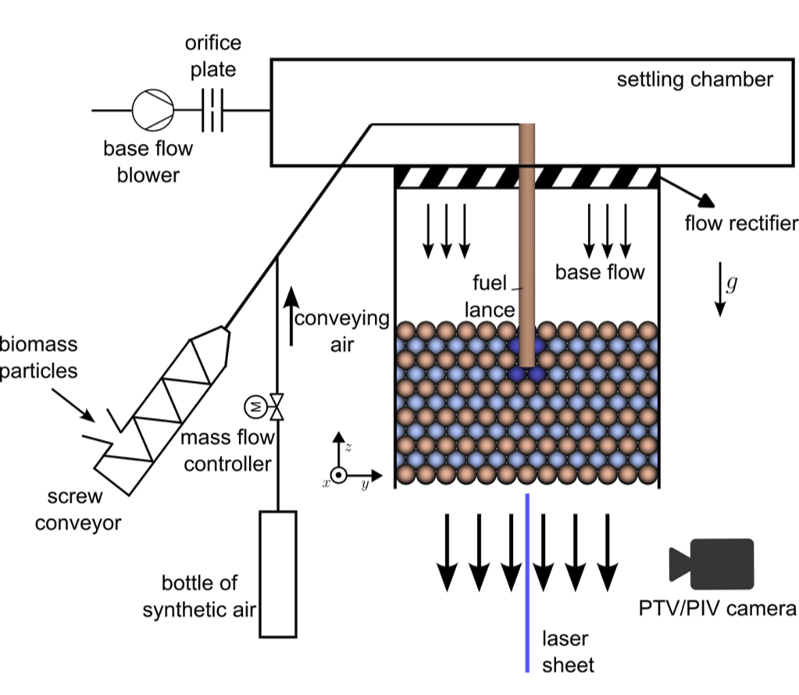
Motivation: Lime shaft kilns are used to convert limestone (CaCO₃) into quicklime (CaO). Limestone particles with typical sizes of 4–8 cm move downward through the shaft under the influence of gravity. These kilns are typically around 20 meters high and 3–4 meters in diameter and contain well over one million limestone particles. Simulating such kilns therefore represents a significant challenge, particularly when the trajectories of limestone particles, the degree of calcination of individual particles, and the mechanical and thermochemical interactions between particles and the gas phase are to be described. The Discrete Element Method (DEM) coupled with Computational Fluid Dynamics (CFD) has increasingly become established as a tool for modeling lime shaft kilns. However, in order to enable the application of DEM-CFD to industrial-scale lime shaft kilns, it is necessary, due to computational time constraints, to use an unresolved DEM-CFD approach. In this approach, the particles within the CFD domain are represented as a porous medium, whose local porosity is determined by DEM. This means that the actual particle shapes and the bed structure are not explicitly resolved on the CFD side. As a result, interstitial flow structures—and therefore the mixing of fuel and oxidizing agent—cannot be captured in detail. Consequently, the local heat release and the associated calcination process in the moving packed bed cannot be predicted accurately. For gaseous fuels, the influence of the packed bed on the propagation of the fuel jet in the unresolved DEM-CFD approach can be approximated using additional correlations for radial dispersion coefficients. However, no dispersion model currently exists for solid fuels, particularly not for biomass with its elongated particle shape. Therefore, this project aims to develop a model that predicts the dispersion of biomass particles in unresolved DEM-CFD simulations.
Objective:
T01 closes this gap by extending the DEM-CFD framework developed in CRC/TRR 287 with a second solid phase: biomass particles of 2–3 mm. Resolved simulations under non-reactive and reactive conditions will generate training data for a machine learning dispersion model, which will then be implemented in the unresolved approach and validated against data from an industrial shaft kiln.